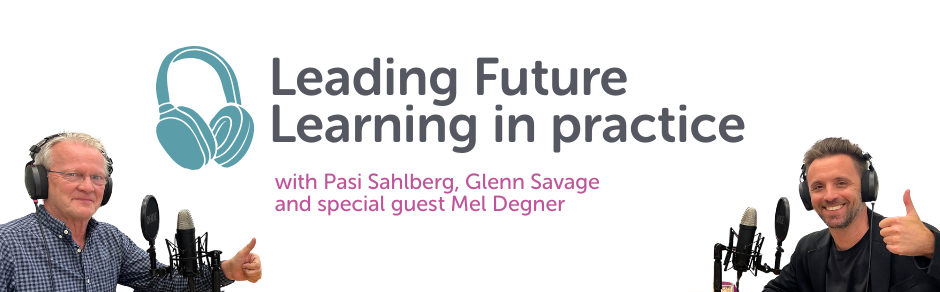
Leading Future Learning program facilitators, Professors Pasi Sahlberg and Glenn Savage, discuss the programs growth and impact with past participant, Mel Degner, principal at Cummins Area School.
This episode explores how professional learning empowers leaders to imagine, design and align with system strategy. It highlights the co-evolution of the program with the South Australian Strategy for Public Education and the impact the learning has had on helping leaders to enact the strategy and implement positive change in their school or preschool.
LISTEN NOW
Transcript
Pasi: This podcast is produced on the traditional land of the Kaurna people. Orbis would like to acknowledge the traditional custodians of the land and pay respects to all Elders, past and present.
Hello everyone and welcome to the Orbis podcast. My name is Pasi Sahlberg from the University of Melbourne. I'm also one of the facilitators from the Leading Future Learning program here at Orbis.
In this episode, we are talking with my co-facilitator and colleague, Glenn Savage Professor and also facilitating the program, and Mel Degner, Principal of Cummins Area School and former participant of the Leading Future Learning program.
Hello, Mel. Can you hear us?
Mel: Yes I can Pasi.
Pasi: Excellent. Thank you so much for joining us. So, you took part in the Leading Future Learning program last year, I guess?
Mel: Yes. Yep.
Pasi: Yeh, so can I start by asking you then - what was the motivation for you to join this program and what initial expectations did you have?
Mel: Yeah. So the motivation was really, we saw it put through LinkEd and we were at a point at our site where we felt like it was time to really embrace the changes that were coming through DfE and see how we could, I guess work with them to change up the educational experience for our students and we knew that we needed some support in being able to do that and was just a good time for us with, you know, my new tenure as Principal and a Deputy with a similar tenure, knowing that we were going to have a considerable amount of time ahead of us to look at some long term work.
Pasi: So there were some of your colleagues joining this as well. How important do you think it is to have more than just the Principal or 1 person from the school in a program like this one?
Mel: I can't emphasise enough the importance of that and to be quite honest, if I did it again, I would bring my whole leadership team somehow or other, or at least a few more of them. So certainly having my Deputy alongside of me to work through that program was incredibly beneficial. I couldn't imagine doing it on my own.
Pasi: Yeah, we have the same experience here with Glenn. Glenn, you are one of the co-designers of the program. Let’s share with the listeners a little bit about what are we talking about. Could you talk us through a little bit about the approach of the Leading Future Learning program and how do you think it's different from what people usually have in a leadership professional development?
Glenn: Yeah well I mean, I think a lot of professional learning programs are kind of ‘one offs’. You know, you go along and you hear someone talk about AI, or you hear someone talk about you know, wellbeing or something like that and then you go back to school and you know, you kind of left to think - well, how am I going to take those insights and integrate them into what I'm doing?
This is a very, very different process. This is more about saying, what kind of initiative or innovation would you like to see happen in your school community and how can we work with you, as in, we facilitators work with you to help you co-create that? But also, how can you go back and work with your communities to inspire that conversation around the future of schooling and to generate something that we do together?
And then the way it, as you know Pasi, the way that the program works is we don't just see the participants and then we never see them again. We work with them over a period of you know, nearly a year. We do 2 days, then we do online check in sessions and design consultations with them, work with them over the course of the year, see them again for 2 days later in the year and then again subsequently, you know, 3 to 6 months later, check in and see where they're at and where they need support and how they might need to recalibrate.
So this notion of leading future learning, it really hinges on the idea of working with school leaders to imagine, to aspire, you know, what kind of future do you want to bring about for your school and your community? And then we support them through a method to get there, to develop a change initiative and to bring it about in their sites.
Pasi: So, Mel, how did this type of program design that Glenn was explaining, work with you and your colleagues there?
Mel: It was fantastic, and I think Glenn hit the point about the continuation of the learning throughout the course you know, and it's true, we often go to PD and then, you know, really embrace it. But come back in the business of school actually stops us from, I guess, following through as probably quickly as we'd like or as authentically as we like and I think the advantage of this was knowing right from the start that there were the 4 days, that they were at a really sensible period of time apart, that allowed for you to go back and do what you wanted to do in that period of time, stay connected to Daniella and Pasi and Glenn, but also so there's a bit of accountability in there, but also the support piece I think, which is probably more important than even accountability, that knowing that you have people with their expertise and knowledge to then support you to do what you want to do, and that you can have the online check ins and the emails and the phone calls and the, ‘Here's what we're thinking, what do you think?’ process, which really for us as a site was incredible. Like it's probably the most powerful piece of PD I've done as a leader as far as that change process in how to actually step yourself through it.
Pasi: Yeah and one important aspect of this program has been what we call the ‘change initiative’ that the schools and leaders like yourself Mel, were able to choose and develop and then, you know, start to implement, put in practice in the schools. Could you describe a specific change initiative or idea at your own site that was directly inspired by the program Mel?
Mel: The program’s really enabled us to strengthen our commitment to what we want our students to be and one of the most effective areas that we've seen growth in this year is in in our family engagement piece. As part of the project, we've really looked at how do we get our parents into our school more regularly, but not just how do we get them into the school, but how do we do that in an authentic way? So, we've been throughout the year having regular ‘coffee with leaders mornings’ that then lead in to families and parents and community members going into our crew sessions, which are pastoral care type sessions, and parents have really loved the opportunity to come and casually meet with leaders, chat with them about what's going on in the school, then go on into their children's lesson and actually experience the lesson alongside their children so they understand what it is that we're trying to achieve and we've seen significant uptake from the first event to, at the moment, we're getting a number of families in every time we run them. We originally ran them just 3 times a term for the whole school at once, and it became clear pretty quickly that we needed to run them more often and to spread out different areas of the school, because children were getting upset that their parents couldn't come in because there's only 1 parent available and 3 kids in the school.
Pasi: Sounds wonderful. Orbis and obviously all of us, when we facilitate the big program, like this that we are interested in and concerned about the impact and what happens and what changes. Is there anything Mel that you can say about the impacts yet about this initiative that you've described?
Mel: Yeah, what we've already seen in this short period of time is, our wellbeing and engagement data is definitely showing higher sense of belonging and connectedness to our school site, which was an area that we were concerned about and we're also seeing greater engagement in learning from our students from some of the changes that we've made. So at the moment as I said, some of that's reflected in our wellbeing and engagement collection data which is system driven data, but also the data that we are collecting here on site ourselves and is showing the, you know, engagement piece is definitely lifting and we expect that that will then continue to, well we hypothesise I should say, that that will then continue to flow on into achievement and outcomes as well.
Pasi: Excellent. Yeah. That is really good to hear. Glenn, one important aspect from our point of view in the program like this is obviously the development of leadership thinking and values and how school leaders see their work and the future as well. We have seen a lot of people, colleagues of Mel going through during this couple of years.
Can you speak a little bit about what you've noticed about the evolution of leadership thinking specifically among the participants in the Leading Future Learning program, and particularly probably regarding the new Strategy for Public Education here in South Australia?
Glenn: Yeah, absolutely. I mean, I guess I should start by saying that I truly believe that South Australia is a special and different place when it comes to education reform.
Pasi: I agree.
Glenn: We've had many, many conversations about this and you know, I think if you look closely at what the Strategy for Public Education is asking of school leaders, it's actually asking them to be leaders, to be experts, to be the drivers of change within their local community and a strong emphasis I think, in there on making contextually embedded decisions around what works best for their community.
One of the things that has been really core to the vibe or to the orientation, for want of a better word, in this program, is that we've tried to steer leaders who do the program away from a very fixed notion of what works in schools. In a lot of systems in Australia and globally, there's a very strong orientation coming from government that effectively says, look we have the evidence, we know what works, this is what you need to do and go and do it and then we're going to see improvements. And I think what the strategy in South Australia is allowing for is a different way of thinking about that dynamic and saying, look, there is a lot of evidence out there about things that can potentially improve a whole range of areas in schools, but ultimately that decision needs to be made through a contextual lens, and leaders need to ask what might work for them in their particular context.
And we've really tried to take that idea and that angle and work with school leaders. So we're saying to them, we can't actually tell you what to do….and don't expect us to. You know, you come along here and we're working with you to help impart the knowledge and experience we have with systems change and leadership change. But ultimately the decision about what works or what might work for you needs to come from within. And that wouldn't be possible - and I'd be interested Mel actually, to know what your take on this is - but I don't think it would be possible to run a course the way we do it, in a system that wasn't giving permission for leaders to be the drivers of change.
Pasi: Yeah, absolutely. I'd throw it to you Mel, just like Glenn was saying but just for those who are listening to this episode, I think it's good to know that we have had a very diverse group of leaders from all around this beautiful state and also across all the different levels of education, starting from early childhood, primary schools and high schools as well. So it's really, we've been working with a diversity of leaders. But Mel, do you have a response to Glenn’s question to you?
Mel: Yeah, I agree completely and I think that was, for us, it was like all the planets had aligned and I did use that with our whole school community as well as our staff and our students that, you know, we were in a really fortunate situation that we had a system that was giving us permission to try things and to think what was going to work for Cummins Area School and then the course enabled Boyd and myself to feel supported in that in a different way as well. So sometimes it's about you've got permission, but you don't know how to when you've come out of times where you have been quite controlled and it's been quite rigid and quite prescriptive I guess. So, to actually have that permission to have the strategy sitting there and to be passionate believers in it anyway, to then have the opportunity to embrace that under the guidance of the course was next level and I think you're right, 5 years ago it wouldn't have wouldn't have made sense… it made perfect sense and it made the whole process and sharing that with our community so much easier and so much more powerful in the end as well.
Pasi: Yeah and I think Glenn, we've been both privileged to be in this situation where the state has a new strategy.
It actually was in a very draft phase still 2, 2 and a half years ago when we started. So, we have seen the evolution of the strategy as well and then facilitating a program like this where principals from across the state and different sites are joining us to think about this same question, that what this strategy means and you know, what can we do in our school and there are several unique aspects of this strategy.
Would you like to mention some of the things that, from your point of view Glenn, that you can see unique in the state like system level efforts to change/transform the education?
Glenn: Yeah, absolutely and I think as well Pasi, that the course itself has evolved sort of co-evolved with the strategy you know, I think going back to the very (start), we piloted this program to start with, with a smaller group of leaders and at the time when we were piloting it, I think when we started the pilot, the strategy hadn't actually been formally released.
Pasi: That's right, yeah.
Glenn: But by the time we finished the pilot, it had. So even in that very early iteration, we were all collectively trying to make sense of the strategy. What does it mean? What are these areas of impact? What do we make sense of here? What do we have questions about? So, it's been interesting as we've gone along to try and think how can we evolve the program itself to respond to what we think teachers and leaders need at this point in time. And I think, interestingly, this year, in 2025, we can now assume a whole lot of things that we couldn't assume before, when we first started the program.
You know, when we go in and ask leaders about a particular element of the strategy or we start talking about the relationship between excellence and equity which is a key feature, or talking about the notion of effective learners, they know way more than we do about that now because they're living it. They're in the thick of it from day to day and I think that shows a maturity and growth within the system more broadly, and makes us realise that we're just one little tiny cog in what is a learning system.
Pasi: Yeah and in a way we have been privileged to be part of the learners as well in this process as you describe. But you know the other thing is, that we also see the appearance of ChatGPT since we have been doing this - but that's another conversation.
Glenn: I was going to mention that as well.
Pasi: We need to talk about that. But Mel, one thing that you probably remember from the program was that we always bring a couple of international guests and thought leaders into this and I guess that when you took part in the program, we had Pak Tee Ng from Singapore and Ted Dintersmith from the United States.
Can you recall anything that these thought leaders who were visiting through the video conference, about sharing their wisdom that they have influenced your thinking or leadership or work at all?
Mel: Yeah, absolutely. Pak Tee really, I guess has resonated with me a lot around his idea of centralised decentralisation. I was like… as soon as that conversation came in, it just made so much sense and you know, it's obviously what we're practising here in South Australia anyway - that idea of us working together as a system, but that contextual piece.
Pasi: Yeah. You know, the question comes to mind related to the overall when we are wrapping up now, this conversation about, you know, something like the Leading Future Learning program that is a different, it's a kind of a transformational approach to leadership in schools.
And this is for the both of you that, how do you see the program like this contributing to a long-term system transformation here in South Australia? And you can answer very briefly if you wish, but I'm kind of a curious to hear both of you, how you see this. Mel, do you want to start?
Mel: Frankly, from my perspective, what I think it did, it's given me a different level of leadership awareness that I never had before, which probably sounds a bit weird, but I think it was that, that time and space to look at myself as a leader and to understand that change process in a very selfish way. Apart from a lot of the leadership work that we do, that is often as part of our portfolios and things like that, and it's quite often a bit more generalised. And I think the style of the Leading Future Learners program gave Boyd and I permission to look at Cummins Area School, just Cummins Area School, and tap into some thinking around that.
So, it gave us the time and the privilege to do that. So to me, that's where the strength of it has come in. Just in that whole space of, you know, I guess a bit of a selfish part of the system, but more about us and being part of the system work.
Pasi: Yeah, we hear similar things from many of your colleagues here, throughout this year. Glenn, let’s hear from you.
Glenn: Yeah. I mean, if I had a 1-word answer, it would be cross-pollination. Although I think that's 2 words, hyphenated. But what I mean by that and Mel, you probably have a sense for what I'm going to say as well here, but I think the way we set this program out from the beginning was based in a genuine belief that really powerful learning happens when you can bring diverse networks of people together to share their expertise. You know in any given room of our Leading Future Learning program, we have leaders across different geographical areas, different socio-economic areas, schools. We have people in the early years, we've got people in primary schools, we have people in secondary schools. And each of them knows so much, much more than they realise they know. And we purposely try and find ways in the program to cross-pollinate that knowledge.
And, you know, we have evolved a kind of community of practice style model for the program where, you know, you have the opportunity not only to hear what your colleagues are doing in other sites and to learn from them, but to actually contribute to helping co-create and shape what it is that they're doing through the change initiative in the program. And I really do believe that that kind of networked learning, that kind of professional learning is much, much more impactful, but also has a much longer shelf life because we're not - it's a method, it's a way of working it's a way of learning together that we model, that I hope a lot of the participants take on, and implement throughout the rest of their careers.
Pasi: Yeah. So I have left the easiest question of all to be almost the last one here. So this is for both of you and the question goes something like this, that what do we need to do now in our schools to prepare young people for the future? Like 1 or 2 most important things.
Glenn: Yeah, he says easy doesn't he Mel? And then he throws the hardest question possible at the end.
Mel: I was just thinking the same. Oops.
Pasi: Yeah. Okay, Mel I'll give you some time to think. I know that Glenn is always ready for this question.
Glenn: Well look I mean, I think that there are so many complex possibilities and also headwinds that are facing schools right now. And, you know, it's almost become a bit of a stereotype to say you know, schools need to change. They need to become something different than what they are and have been for the last 100 years. But I think it's becoming increasingly obvious to anyone involved in education, just the significance of the changes that we're going to see globally in the years ahead.
We haven't talked about AI, but it's interesting that the first ever version of Leading Future Learning we did, you know, we asked the question to leaders - we said, ‘How many of you have used ChatGPT?’
Pasi: And many of them say, ‘What's that?’
Glenn: Most of them said, ‘What's that?’ Now, if you're listening to this you're probably thinking, no way. Like, this was only a few years ago, right? But it's true. Hand on our hearts, you know, like the people did not, were not using it. And when we, you know, sort of tried to model some ways in which we use it as academics or we were beginning to use it at the time, people were a bit freaked out, I think. Now, fast forward a few years on and almost no question we pose isn't answered partly with AI, without leaders asking AI for its views on what it means for them, looking up evidence, resources, ways of thinking. So that's just 1 example of how rapidly things have changed in that space in 24 months or so. So, I mean, I'm sort of dodging your question slightly because I don't have a fully formed answer that will be all encompassing, but I think what are my biggest feeling around this from a leader's perspective, is that leaders need to be adaptive. I think, you know, there is no 5 key things or 3 tick-a-box things that we can say, this is this is going to hold you in good stead for the rest of your leadership career.
Maybe the only one would be that you have to be nuanced in your thinking, creative in your thinking, and adaptive in terms of your leadership, because the changes that we're going to see more broadly, globally, economically, socially, technologically are going to impact schools just as much as they will impact other places. And leaders need to be ready for that and to think, what is my role here? You know, what is it that I need to do as a leader to help steer my community? It's a huge responsibility but it requires a level of agility I don't think we've ever seen before.
Pasi: Yeah. So, Mel, you lead learning and school every day. Well, what's your response to this? What do we need to do for preparing kids for the future that we don't know what it is?
Mel: Yeah. It's tricky. So I guess what we did, and so what we're looking at here, is what do we want? We want people to be part of our community and whether that's in the smallest sense of our school community to the broadest sense of the world community. So what are the, I guess, skills and concepts that we need to be thinking about for our students to be those people moving forward? The people with the empathy, the ability to think and be thoughtful and I guess that's kind of where we're looking, is thinking and it's a bit of a cliche I know, but that sense of holistic education where we know that, it's not an individual target anymore around having kids ready for uni or an ATAR or something like that, but it's actually about what are we doing to, I guess, keep our world, that is ever changing moving along well?
Pasi: Yeah, yeah, that's so wonderful. Glenn.
Glenn: Can I just jump in. I was reminded when you were speaking Mel, of Pak Tee, and I think he made the point when he was asked a question about AI, you know, he said back to the person who asked the question, well, look if artificial intelligence is artificial intelligence, then what is human intelligence?
And I think, you know, that's a really important question. I think moving forward, like what is it that's distinctive about the work of a school and the work of teaching a human to be human? And what's that going to look like? And, Pasi you mentioned earlier today when we were chatting, that you know, what we don't want is a future where teachers and leaders are planning all their lessons on AI, giving assignments to kids that have been written by AI, and then they're getting back assignments that have been done on AI that are then marked on AI. What's the point of any of that?
Pasi: Where's the learning?
Glenn: Where's the learning, and what's the point? You know, we don't - so we need to - there's a bigger picture question here around what it means to be human and to be taught.
Pasi: So before I let you go, this has been fascinating conversation. I would love to continue on and on. But there may be somebody listening to this episode, wondering that, so where do I get the chance to you know, take part in the program like a similar program like Leading Future Learning? What would your advice be to somebody who is, kind of thinking about, you know, taking the step to join the professional learning program in leadership that would be something like what we've been talking about here. Glenn do you want to go first and then Mel can say the final word?
Glenn: Come along, be involved in Leading Future Learning. We are running Leading Future Learning again in 2026 and would welcome anyone who's interested in these topics to come along and be involved. I think that no matter what your, you know career stage is or the kind of school that you're involved in, this program offers you a way of thinking about change and innovation in your school, and it puts a lot of responsibility on you to actually be creative and think of something to do. So, if that appeals to you, we want to see you next year. So Orbis Leading Future Learning.
Pasi: Okay Mel.
Mel: Honestly it has been the biggest thing probably to influence my leadership ever. And I think my school community would tell you that it's been the best thing for our site. What, we are doing here on the basis of the confidence that Boyd and I got from the course last year has been next level. So, thank you. It's honestly been awesome.
Pasi: Yeah, it's good to hear this. And I also personally I want to say again how big a privilege it's been to be able to, you know meet hundreds of your colleagues Mel and beautiful people across the state and not only meet them once or twice but you know, see the impact and the progress that people make. So, we have seen a huge step forward in South Australia during this 2 and a half years that we've been doing this. So, it's been it's been a great thing. Thank you so much. Mel. Thanks, Glenn.
This brings us to the end of our podcast, unfortunately. This would have been a good conversation to continue. I hope you have found our discussion both insightful and enjoyable.
Thank you everyone for listening and we hope, you'll join us again in the future in this series.